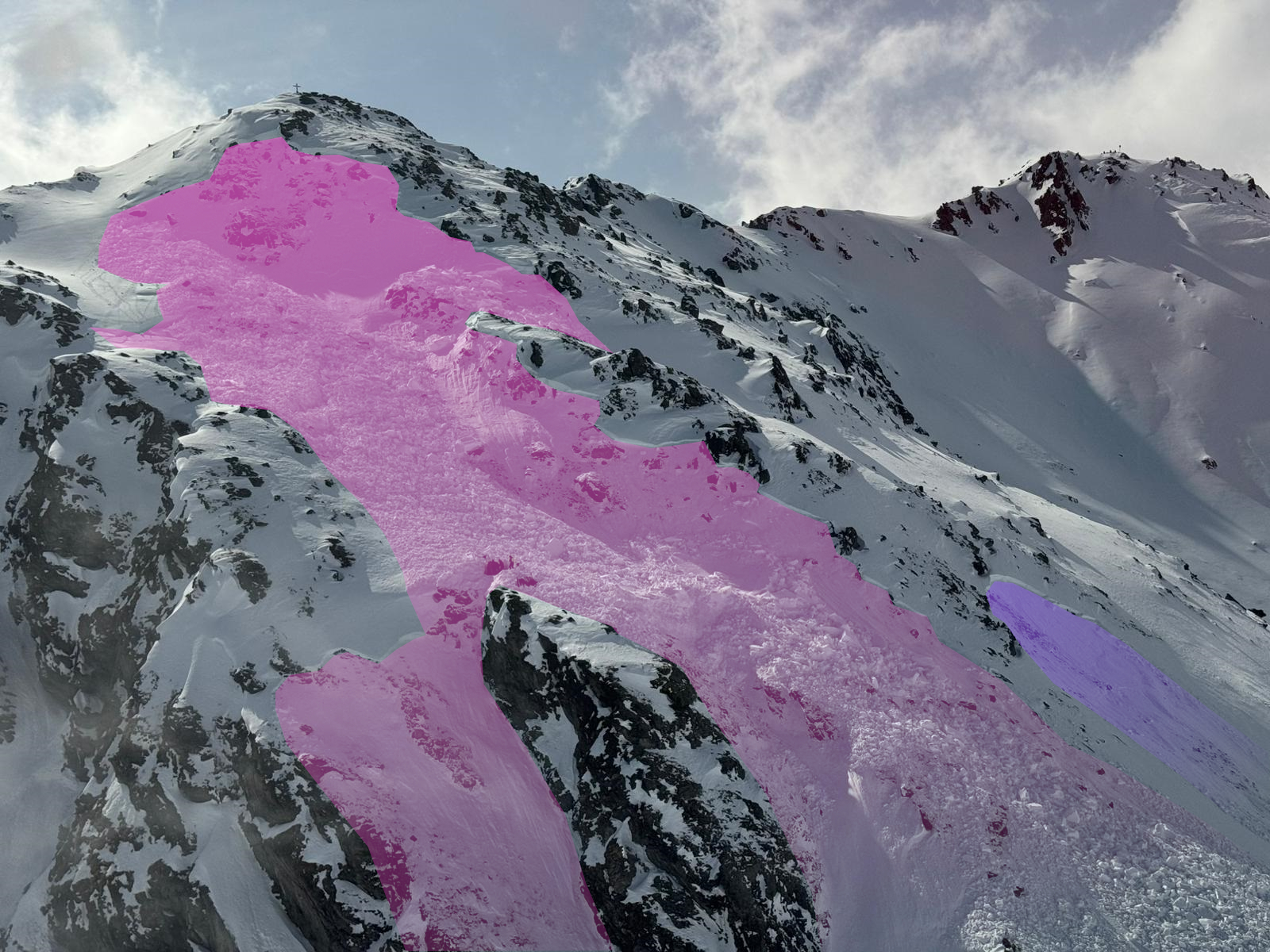
On Saturday, 28.02.2026, two persons were buried and killed in an avalanche on the Tamlspitz in the Tux Alps. The large-sized slab avalanche triggered on a northeast-facing slope at about 2600m. Cause: an expansively metamorphosed weak layer of faceted crystals near ground level in the old snow.
The persistent weak layer problem remains treacherous, slab avalanches still can be easily triggered, grow to large size. Caution also urged below steep slopes!
Unfolding of the event
On Saturday morning, 28.02, two well-equipped backcountry skiers climbed from the Tux side over the Vallruckalm in the direction of Tamlspitz. The Tamlspitz (2608m) is an unseemly shaped elevation about 300m east of the more well known Torspitze in the Tux Alps.
The two experienced backcountry tourers ascended to the summit structure over a broad moderately steep ridge, thereby initially avoiding the north-facing steep slopes below the Torspitze and Tamlspitz. Above approximately 2500m the ascent leads through a bowl in which the terrain repeatedly becomes an additional notch steeper like stairs. Orographically left, the bowl is flanked by significantly steeper parts of the slope; orographically right, on the other hand, it is limited by extremely steeply descending rocky terrain.
Investigations on the scene permit us to conclude that the two backcountry skiers were caught by a slab avalanche at an altitude of about 2450m which triggered above them, immediately beneath the summit of the Torspitze at 2600m. Both persons were caught in the avalanche, swept along and totally buried in snow masses very near to each other in a concavity only a short distance below where they were. The incident occurred just before noon on Saturday, according to examinations of the Alpine Police.


The rescue operation was launched after both persons were reported by relatives as missing that evening. Since the intended goal was known, the search was limited to the zone around the Tamlspitz. Due to the avalanche situation and bad weather Sunday morning, 01.03, the two winter sports enthusiasts could not be localized and dug out until almost noon on Sunday, by means of LVS beamers. Both persons were dead when they were found.

The avalanche
The avalanche was a large-sized slab avalanche (Magnitude 3) which triggered on a northeast-facing slope at 2600m. The upper fracture zone beneath the summit of the Tamlspitz is extremely steep: approximately 45-50°. However with near certainty, the release occurred in terrain which was much less steep, about 100-150m distant from the upper fracture. In the fracture zone the avalanche was about 40m wide, the fracture was an average 80cm deep. The overall length of the avalanche down to the lowermost runout zone was 500m.

The snowpack
We conducted snowpack analysis in the area of the avalanche on 02.03, together with the Alpine Police and the Austrian Army. Cause of the incident was, once again, the expansively metamorphosed weak old snowpack fundament of faceted crystals from early winter. The primary weak layer consisted of faceted crystals and deep hoar which was lodged between melt-freeze crusts. Above the weak layer, the fresh snow and drifts from the most recent period of precipitation was deposited.

