Überblicksbild der Lawine Marchkopf: Rote Pfeile zeigen die Einfahrtsbereiche, das rote Rechteck jenen Ort, wo die zweite Person wartete, jedoch auch von der Schneebrettlawine mitgerissen wurde. Die rote Ellipse zeigt den Verschüttungsbereich der verstorbenen Person (©Alpinpolizei, 28.03.2027).

Avalanche incident Marchkopf – Tux Alps East, 28.03.2026

Below the 2499m high Marchkopf in the “Tux Alps East” region on Saturday, 28.03.2026, two persons were swept along by a large-sized slab avalanche. One person suffered injuries, the second person did not survive the avalanche.

What was most significant for the release was a near-surface weak layer which had formed at mid-March. Atop of it, a solid slab was deposited, generated especially by the snowfall and wind impact starting on 25.03.2026.

Unfolding of the event

Two persons were in the Hochfügen ski area on Saturday, 28.03.2026. Both were active in the freeriding zone during the day and were outfitted with emergency equipment. At the end of their day of skiing they decided to ascend with the “Zillertal Shuttle” cablecar, then climb over the ridge to the 2499m Marchkopf, and from there descend in the direction of Hochfügen. South of the summit, both of them skied into an extremely steep northwest-facing slope. At an altitude of about 2460m, one of them paused below a rock precipice while the other skied down the slope. After a few turns, a large-sized slab avalanche (Magnitude 3) triggered which swept along the person skiing and the person waiting. The latter person tumbled and flipped several times, lost a ski, and landed partly buried in snow masses in the upper area of the avalanche release, was able to scramble free of the snow and immediately launched a search for the other person via LVS beaming device. The buried person was soon located. Together with the rescue team which in the interim had arrived at the scene, the buried person was dug out from 1.5-metres of snow over the next 30 minutes. All reanimation efforts carried out on the spot were without success.

Rot eingekreist ist der Unfallhang unterhalb des Marchkopfes. Es handelt sich um extrem steiles, Richtung NW ausgerichtetes Gelände. (©https://www.openslopemap.org/karte/)
Encircled in red: the incident slope below the Marchkopf. This is extremely steep northwest-facing terrain. (©https://www.openslopemap.org/karte/)

The avalanche

The avalanche was a large-sized slab avalanche (Magnitude 3) with a breadth of 230m and a length of 400m. The average fracture depth was about 40cm. The avalanche fractured on an extremely steep northwest-facing slope.

Überblicksbild der Lawine Marchkopf: Rote Pfeile zeigen die Einfahrtsbereiche, das rote Rechteck jenen Ort, wo die zweite Person wartete, jedoch auch von der Schneebrettlawine mitgerissen wurde. Die rote Ellipse zeigt den Verschüttungsbereich der verstorbenen Person (©Alpinpolizei, 28.03.2027).
Birds-eye view of the Marchkopf avalanche: red arrows show the entry area, red rectangle the spot where the second person stood waiting but was still swept along by the avalanche. Red ellipse shows the area where the deceased person was buried in snow masses (©Alpinpolizei, 28.03.2026).
Lawine mit Einfahrtsbereich, Warteposition und (in blau) jener Spur der teilverschütteten Person, welche mit einem Ski abfahrend nach seinem total verschütteten Kollegen suchte (©Alpinpolizei, 28.03.2026).
Avalanche with entry area (red arrow), waiting spot (red rectangle) and track of the partially buried person (blue line) who skied on one ski to search for the completely buried companion (©Alpinpolizei, 28.03.2026).
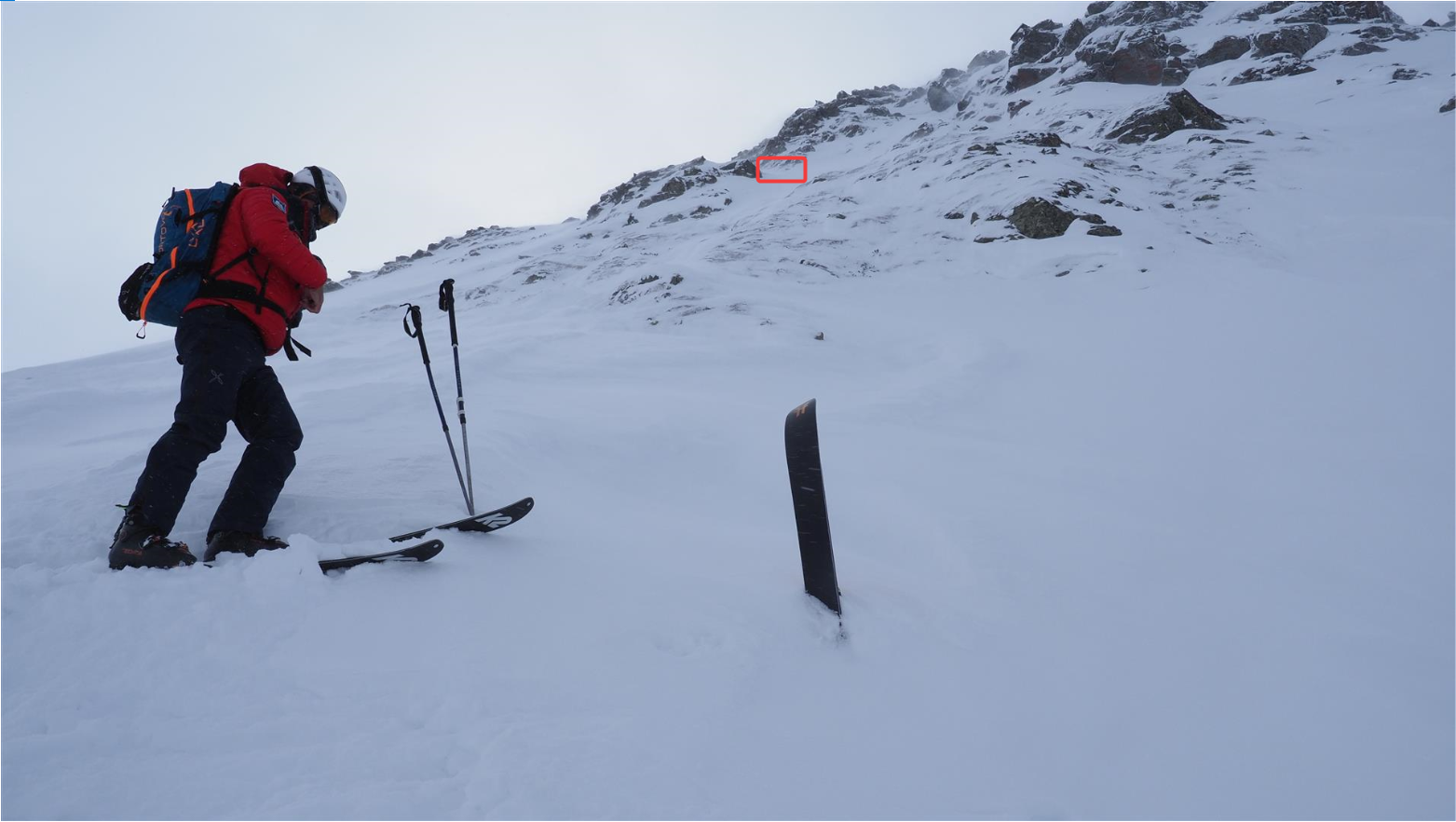
Die teilverschüttete und verletzte Person verlor in der Sturzbahn einen seiner Skier. Das rote Rechteck zeigt die ungefähre Warteposition dieser Person (©LWD Tirol, 30.03.2026).
The partially buried, injured person lost one of his skis in the plummet path of the avalanche. The red rectangle shows the approximate spot where the person stood waiting (©LWD Tirol, 30.03.2026).
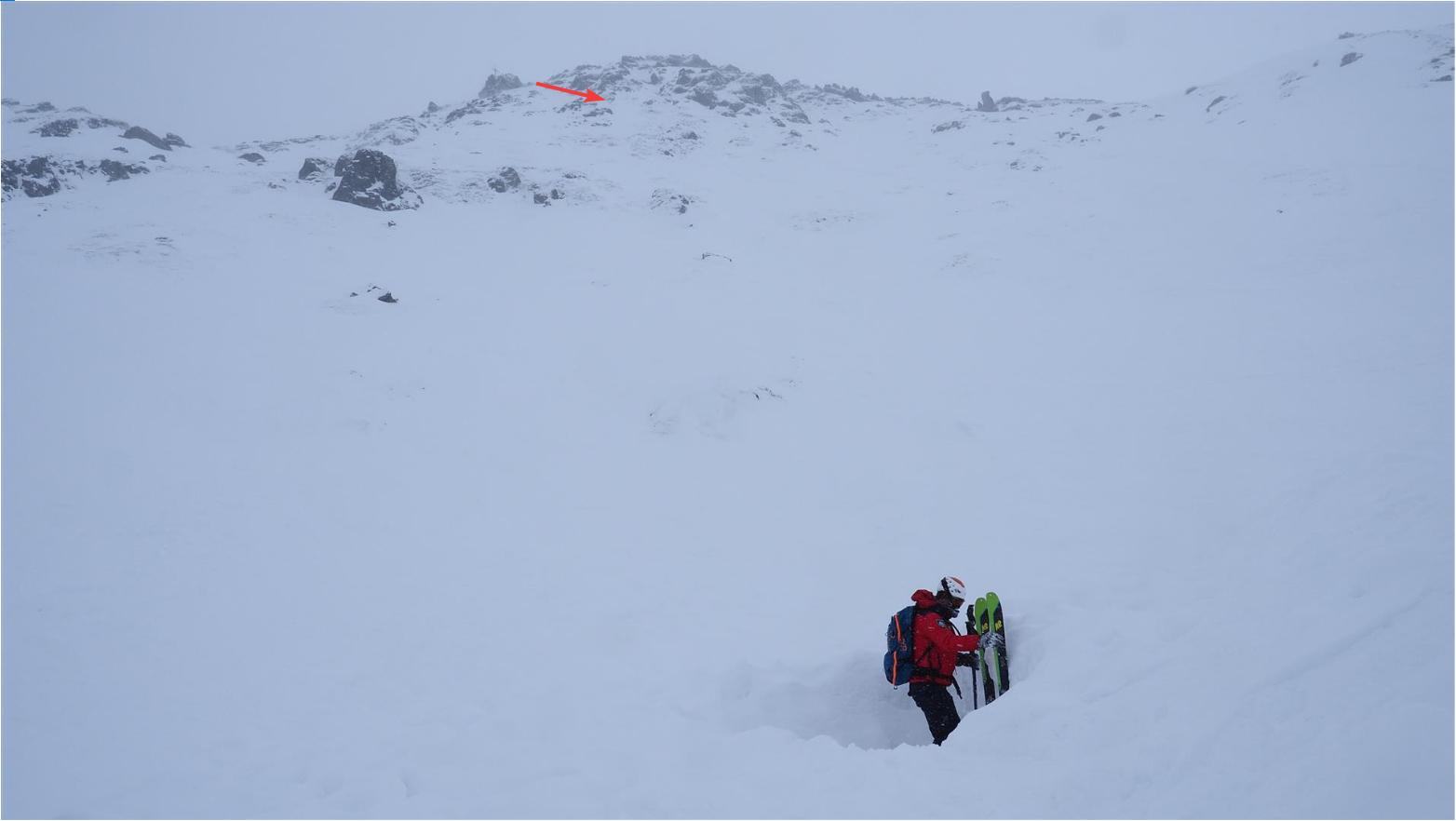
Die Verschüttungsstelle. Der Pfeil zeigt die Einfahrtsspur (©LWD Tirol, 30.03.2026).
Spot where the person was buried in snow. Arrow shows the entry track (©LWD Tirol, 30.03.2026).

The snowpack

Together with the Alpine Police, we carried out an analysis of the incident including a thorough examination of the snowpack. In this we were able to confirm the evidence of a near-surface weak layer which was generated in the period of fine weather during the first half of March. This weak layer of faceted crystals was evident both above and below a thin melt-freeze crust. Our stability tests had varying results. At one spot where a snow profile was taken the snowpack was extremely prone to triggering, at another snow profile no fracture could be generated in the weak layer. (In the latter instance directly at the point the avalanche fractured, the primary fracture occurred in the thin, faceted layer above the melt-freeze crust.) Nevertheless, the weak layer(s) bordering the thin melt-freeze crust were continuous throughout the slope so that far-reaching fracture propagation was possible.

Am orographisch rechten Lawinenanriss: Man erkennt oberhalb der Lawinengleitfläche anfangs eine weichere Schicht, folgend von einer dünnen, härteren (Schmelzharsch-)Schicht. Darüber lagert nochmals eine dünne kantige Schicht. Anschließend folgt das für den Schneebrettabgang notwendige Brett (der meiste Schnee stammte von den Schneefällen zwischen dem 25.03. und 27.03.2026) (©LWD Tirol, 30.03.2026).
On the orographic right of the avalanche fracture: visible is an initially soft layer above the sliding snow masses of the avalanche, followed by a thin, harder layer of breakable melt-freeze. Atop of that there was another thin faceted layer. Finally, the requisite slab was deposited (most of the snow stemmed from bouts of snowfall between 25.03 and 27.03.2026) (©LWD Tirol, 30.03.2026).
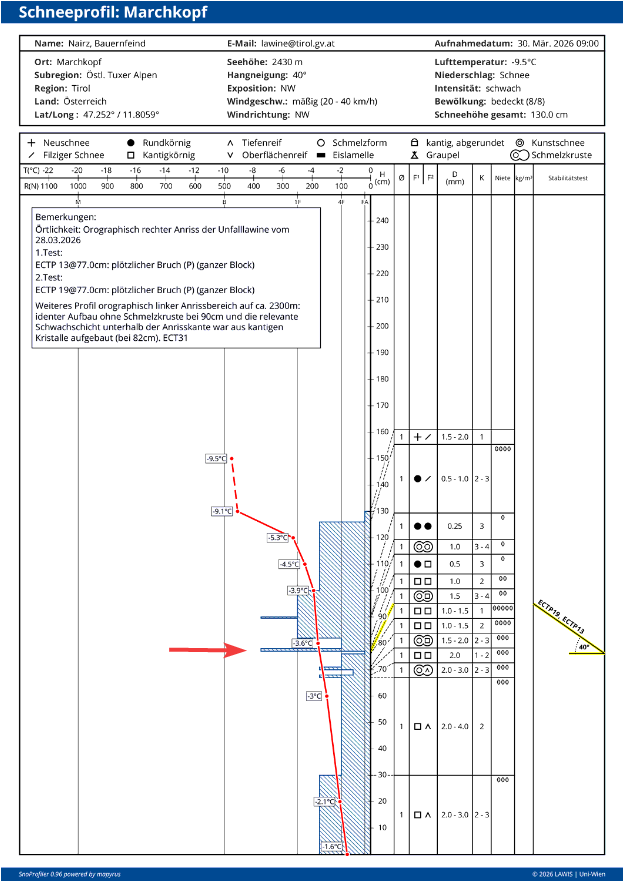
Das zum oberen Bild passende Schneeprofil. Der rote Pfeil symbolisiert die dünne Schmelzkruste von der ersten Märzhälfte. Darunter befindet sich die für den Lawinenabgang an diesem Ort bedeutsame Schachschicht aus kantigen Kristallen. Spannend für uns ist die oberhalb dieser Schmelzkruste vorhandene kantige Schicht. Wir gehen davon aus, dass sich diese nach den unergiebigen Schneefällen am 12.04. durch das im Blogbeitrag vom 20.03.  erwähnte Phänomen "radiation recrystallisation" gebildet hat und von den Schneefällen zwischen dem 15. und 17.03. überlagert wurde (nachfolgende Schicht aus rundkörnigen und kantigen Kristallen). Die darüber befindliche dünne Schmelzkruste stammt von den folgenden Schönwettertagen, darüber lagert der Schnee der ergiebigen Schneefallperiode zwischen dem 25.03.2026 und 27.03.2026.
Snow profile corresponding to the photo above it. Red arrow symbolizes the thin melt-freeze crust formed in the first half of March. Below that is the weak layer of faceted crystals which was significant for this release at this spot. What was highly interesting to us was the faceted layer above this melt-freeze crust. We assume that it was generated following minor snowfall on 12.04 by the “radiation recrystallisation” phenomenon we reported in the blog on 20.03 and was then blanketed over by snowfall between 15 and 17 March (the layer of round-kernel and faceted crystals which followed sequentially). The thin melt-freeze crust on top of that stems from the following fine-weather days, and atop of that the snow from the period of heavy snowfall on 25-27.03.2026 was deposited.
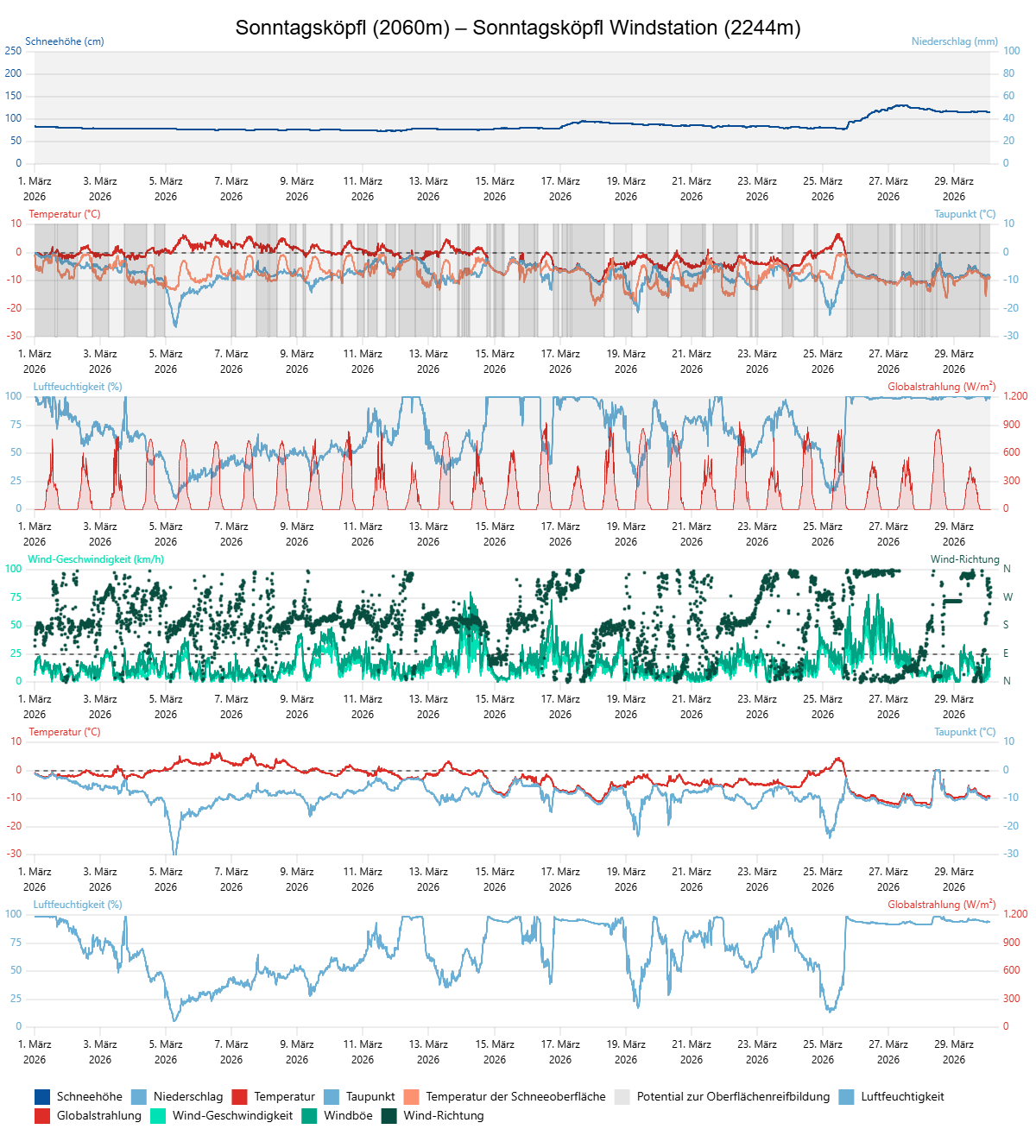
Hier noch der Wetterverlauf seit Anfang März an der im Nahbereich befindlichen Wetterstation Sonntagsköpfl. Anfangs lange Schönwetterphase, dann etwas Schnee (12.03. und 15.-17.03.). Nachfolgend überwiegend freundlich  mit Beginn der starken Schneefälle ab dem 25.03. samt stürmischem Wind, der am 28.03. deutlich nachließ.
Above, weather developments since the beginning of March measured at the Sonntagsköpfl weather station in the vicinity of the incident. Initially, an extended period of fine weather, followed by some snowfall on 12.03 and 15-17.03. Then a by and large pleasant-weather period until heavy snowfall set in, starting on 25.03, together with storm-velocity wind impact, slackening off significantly on 28.03.

Saturday, 28.03: an accident prone day

The first day of beautiful weather following a phase of stormy winds and heavy snowfall very frequently bears a higher risk of avalanches. This was confirmed by the reports of avalanches received at Tirol Headquarters last Saturday. All in all, there were 23 avalanches reported, most of them negative events, one avalanche release – on the Marchkopf – was the single event with injuries and one death.
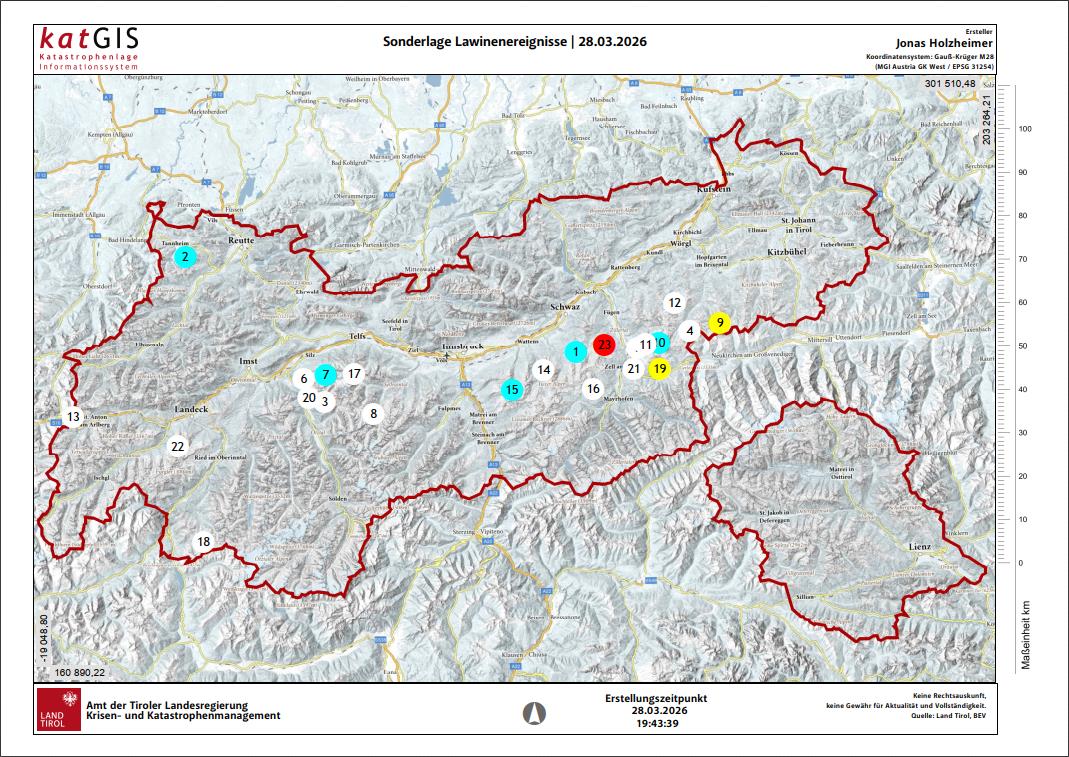
Zusammenstellung der von der Leitstelle Tirol gemeldeten Lawinenabgänge am Samstag, den 28.03.2026. Rot: Tödlicher Lawinenunfall Marchkopf. Gelb: Lawinenabgänge mit Teilverschüttung (unverletzt). Türkis: Lawinenabgänge, bei denen Hubschrauber zur Abklärung vor Ort waren. Weiß: Negativlawinen ohne weitere Veranlassungen (©Landes-Warn- und Lagezentrum Tirol).
Composite map of the avalanches reported to Tirol Headquarters on Saturday, 28.03.2026. Red: fatal avalanche incident Marchkopf. Yellow: avalanche releases where persons were partially buried but suffered no injuries. Turquoise: avalanche releases where a helicopter landed to investigate the incident. White: negative events without any further investigation necessary (©Landes-Warn- und Lagezentrum Tirol).

All the avalanches we’re aware of were results of the near-surface persistent weak layer problem discussed in two different blogs (20.03. and 26.03.), which was also corroborated by the snowpack examination and analysis we carried out on Saturday 28.03.2026 with the Alpine and Airbourne Police. The area which was most prone to triggering was clearly west-facing and north-facing slopes at an altitude between 2200m and 2800m.

Newly added to this: freshly generated snowdrifts, prone to triggering
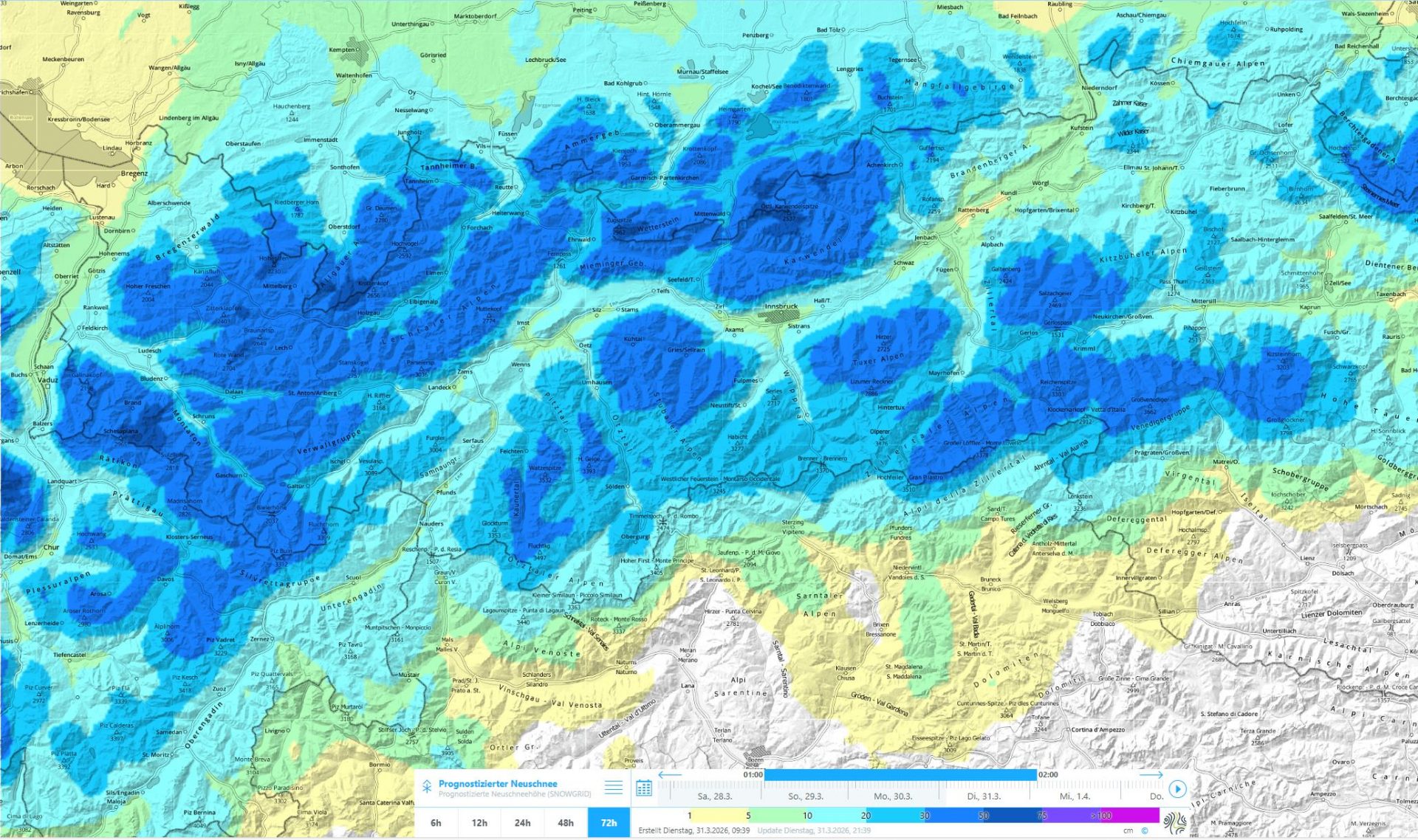
72h Neuschneeprognose. Es bleibt vorerst noch winterlich.
72-hr forecast of fresh snow. It will remain wintery to start with.
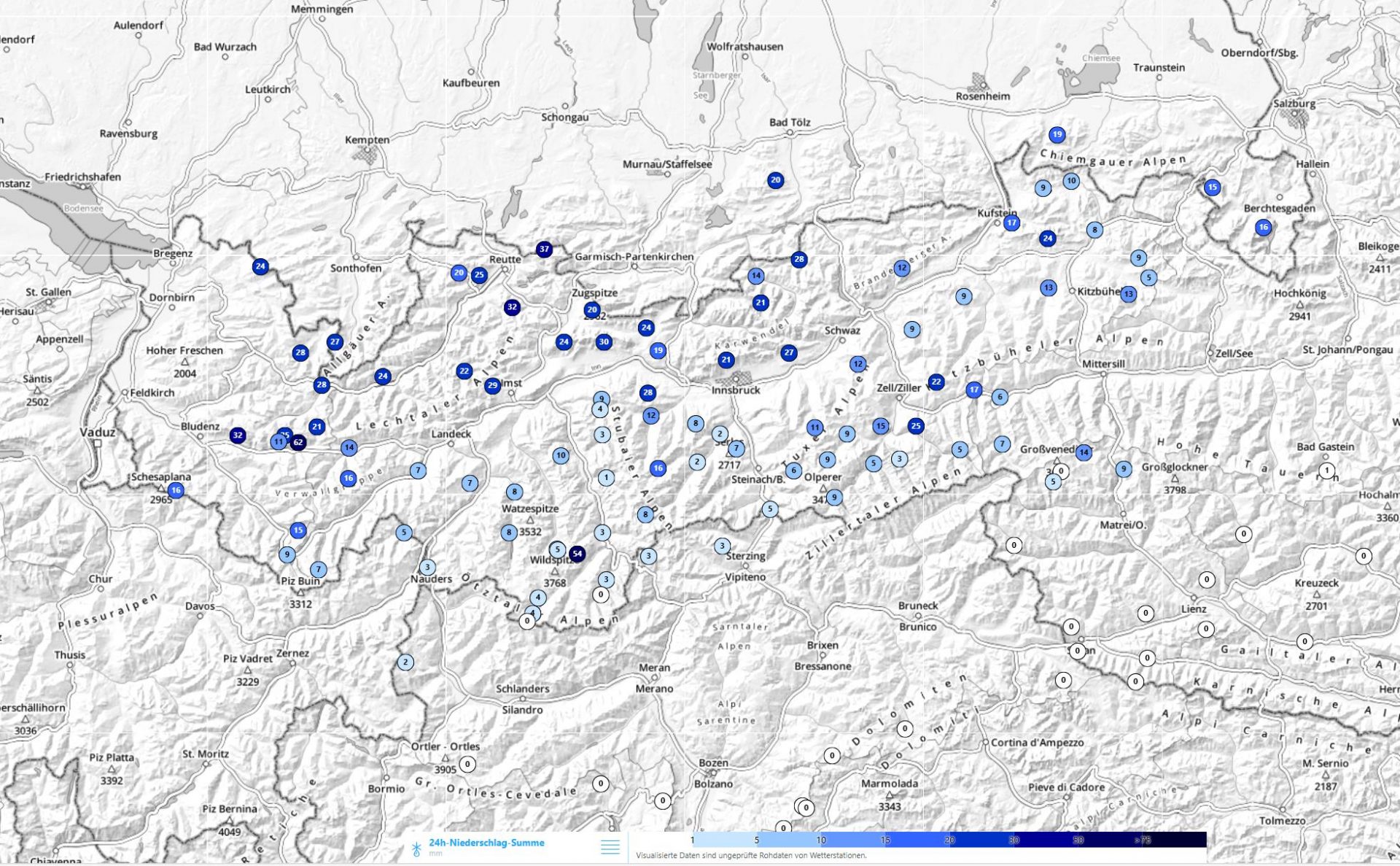
24h-Niederschlag (mm) (Stand: 31.03.2026 10:15 Uhr)
Precipitation measured until now in mm (cutoff date: 31.03.2026 10:15 o’clock).
Vorherrschendes Triebschneeproblem mit entsprechendem Verfrachtungspotential
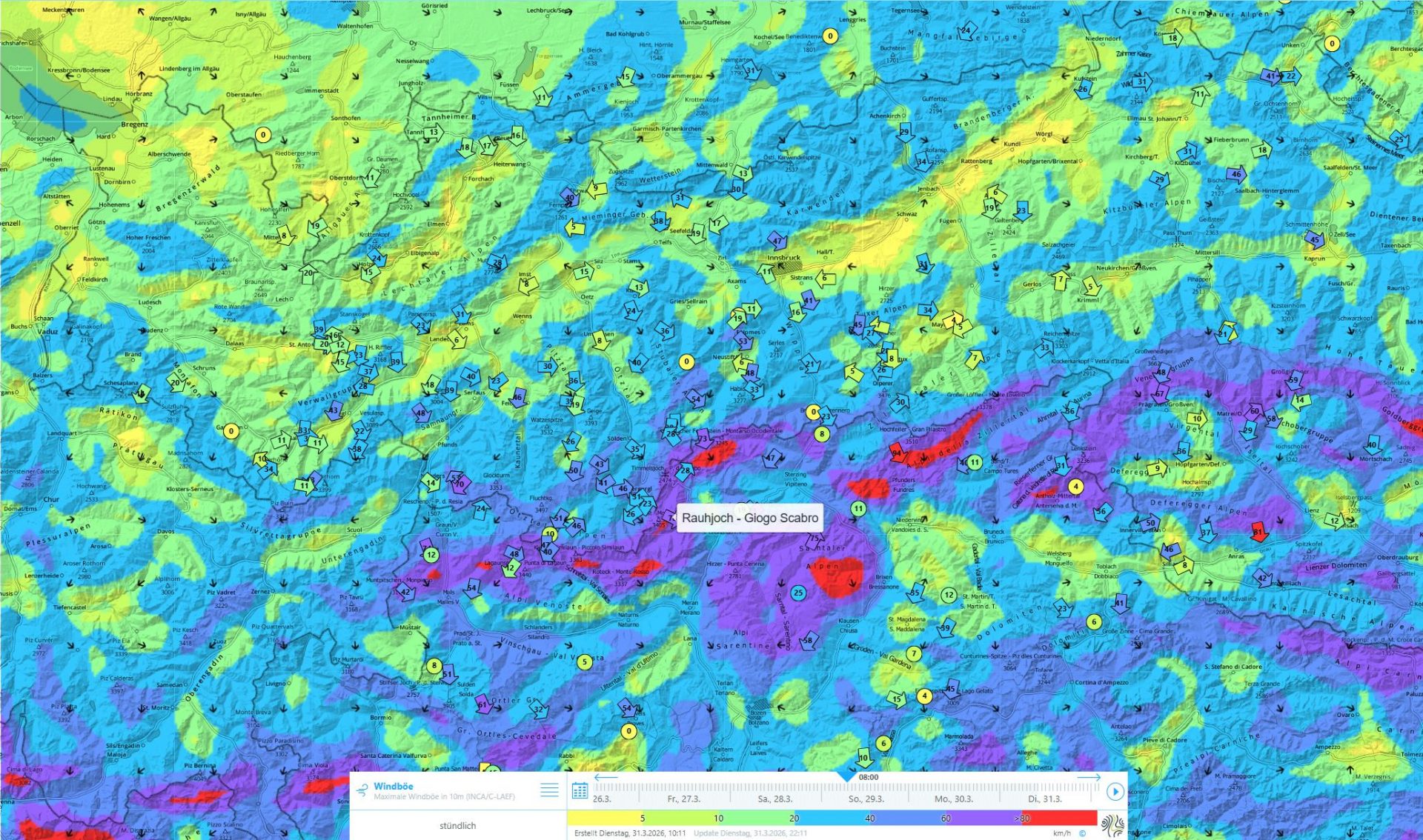
Strong winds are intensively transporting the fresh fallen snow.