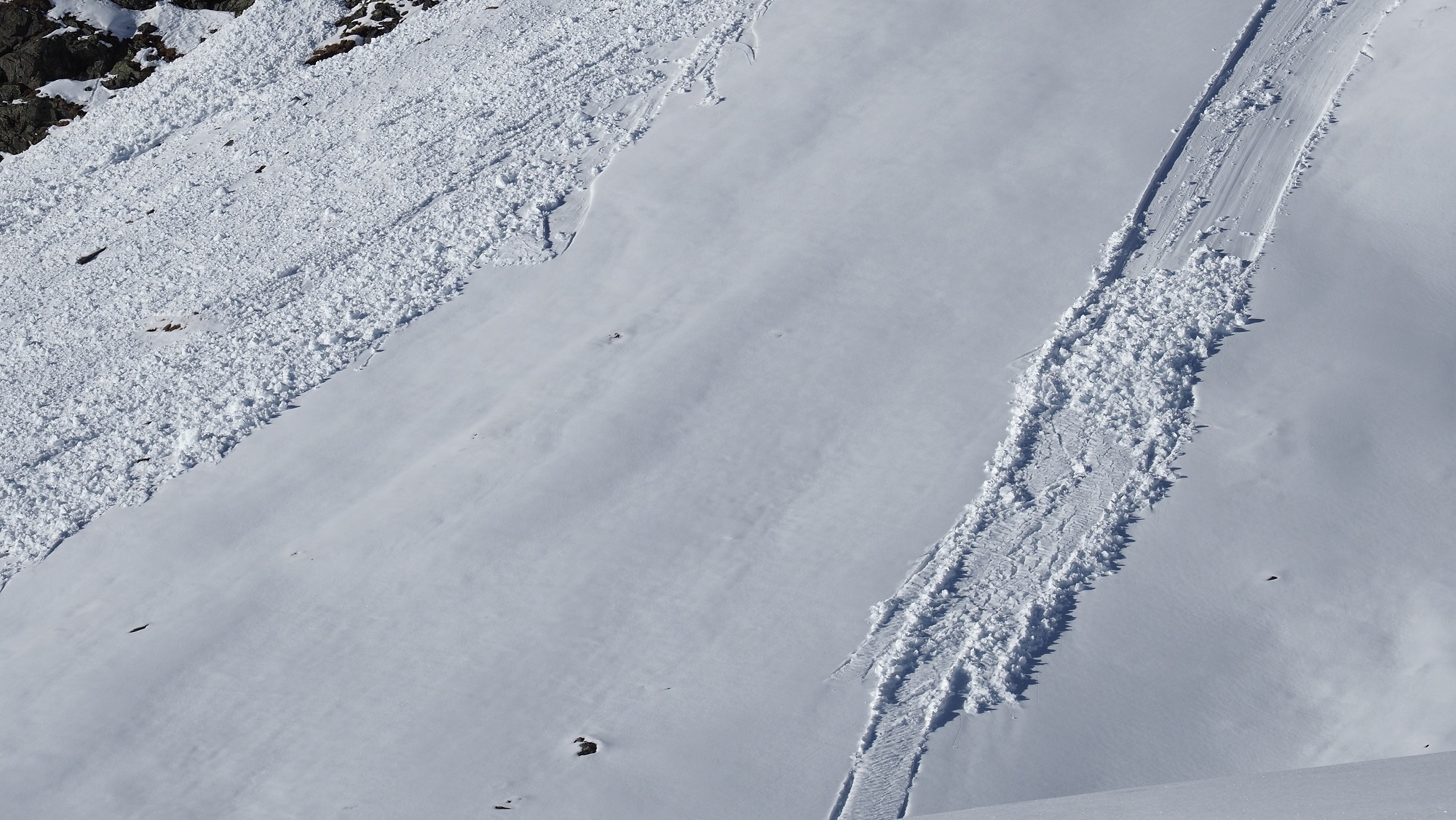
The avalanche situation in Tirol is favorable, but adequate backcountry tours are scant due to lack of snow. At least until the end of next week, high-pressure front weather will predominate, thus, no change is in sight. For this juncture of the season: too mild, too sunny, too dry.
Few danger zones for avalanches to trigger
All in all, with a view of possible avalanche dangers, we are confronted with two problems, currently assigned Danger Level 1, signifying they are not marked. The first: small-sized glide-snow avalanches on steep grass-covered slopes. The second: on extrmely steep shady slopes at high altitudes, small slab avalanches can in isolated cases release in gullies and bowls.
What is important in this context: low avalanche danger does not signify no avalanche danger. True, avalanche prone locations are found seldom in Danger Level 1, often only in extremely steep terrain (>40°), but in such steep terrain there is also the danger of taking a fall. Which means that even a small avalanche – which would be no problem in other terrain – could be fatal.


Generally speaking, other dangers are currently coming to the forefront: since there is such a small amount of snow on the ground, the dangers of rocks and hard ground are a threat to skiers and boarders in off-piste terrain. Also the rain crusts up to at least 2600m from Monday have created a “bone-breaker” – breakable crusts are a real threat. The best bet for skiers is to stick to sunny slopes wherever there is sufficient snow and where the melt-freeze crusts can often turn to firn snow, depending on altitude.

Outlook: stable high-pressure front weather, no change in the avalanche situation
The weak cold front that brought us a bit of gloomy weather north of the Main Alpine Ridge today, Thursday 11.12, will be over by tomorrow, Friday. Stable high-pressure weather conditions, mild temperatures, lots of sunshine, little wind form the expected scenario for the weekend. That means hardly any change in avalanche danger, it will continue to be low. Avalanche prone locations for dry-snow avalanches will become fewer, steep south-facing slopes are becoming bare of snow.


Review of last week
Artificial snow-slab on Leppleskofel
A brief interesting detour: a naturally triggered slab avalanche which unleashed last Saturday, 6 December, on Leppleskofel inside the ski area of St. Jakob in Defereggen.
The precise location: a part of the regular piste No. 11, a steep northwest-facing slope with a gradient of 30 – 35° at 2550m altitude. At the time of the avalanche, neither the lift on Leppleskofel nor the piste were open. There were no persons involved in the avalanche. The only damage caused by the snow masses was a single snow-cannon that was swept along.
What is interesting is the combination of slab plus weak layer which led to the avalanche’s release. The slab consisted primarily of artificial snow. During the hours and days prior to the triggering, this zone was intensively blanketed with artificial snow. However at ground level there was a weak fundament of large-sized faceted crystals constituting a weak layer which developed in early winter when the natural snow cover expansively metamorphosed during a phase of fine weather. The snow cannons stopped making snow about an hour before the avalanche, due to mild temperatures. Moreover, one person skied down the slope without triggering the slab.


Rain up to high altitudes led to frequent naturally triggered avalanches for a brief spell
The warm front which passed through the land from Sunday afternoon until Monday afternoon (7-8 December) brought 20-40mm of precipitation to northern and western regions of North Tirol, between 10 and 20mm south of the Inn and in the Hohe Tauern. The ascending snowfall level was striking. Monday morning it rained up to 2600m. In the moist and warm air, a thin melt-freeze crust formed on the snowpack surface up to over 3000m in some places.
As a result of the warmth and the water seepage into the snowpack, there were frequent naturally triggered wet loose-snow avalanches registered which particularly on shady slopes swept along the soft, metamorphosed snowpack all the way down to the ground, sometimes reaching medium size. Also near-surface slab avalanches were reported, frequently released on surface hoar. In addition, the gliding snow activity on steep grass-covered slopes increased for a short time.


